Showing posts with label Giotto. Show all posts

Friday, September 4, 2026

Venezuela

Giotto 
Angélica 
Los Angeles 
The Netherlands 
Venezuela
San Antonio 

Proverbs 6:6
“Go to the ant, thou sluggard; consider her ways, and be wise:” 


"The lanterns gilded the leaves of the trees"~~~Flannery O'Connor


Chess: "Giotto" "Angélica" "Los Angeles" "The Netherlands" "Venezuela" "San Antonio"
 
 
 Query with Copilot this morning: 

-Good morning! Is there a way in which we could connect one of the multiple meanings of Giotto's painting with Prov. 6:6 ?
 
-Good morning, Jorge — sí, absolutely, there is a deep, elegant way to connect Giotto with Proverbs 6:6.
And it’s not obvious — which makes it even more beautiful.

Let me give you the core idea first, then unfold it:

Giotto paints the drama of salvation through bodies in motion;
Proverbs 6:6 teaches salvation through attention, diligence, and quiet wisdom.
The ant is the hidden geometry behind Giotto’s diagonals.

Now let’s build the bridge.

⭐ 1. Proverbs 6:6 — the ant as spiritual geometry
“Go to the ant… consider her ways, and be wise.”

The ant is:

small
unnoticed
constant
purposeful
moving along invisible paths
building what is not seen until it is complete

The ant’s wisdom is directional — a tiny creature following a line, a vector, a path of purpose.

That is exactly where Giotto enters.

⭐ 2. Giotto’s diagonals = the ant’s path made cosmic
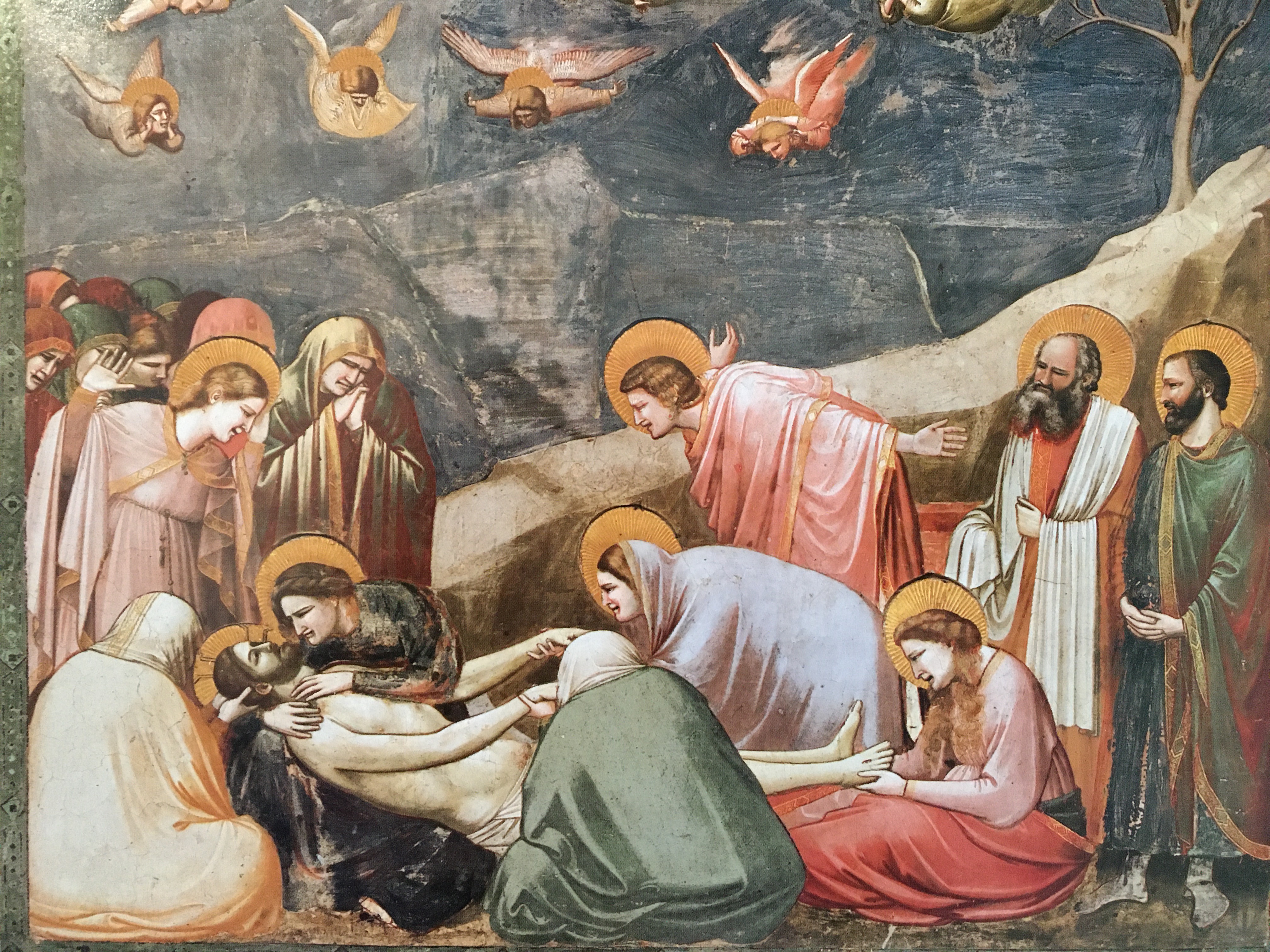
In the Lamentation, Descent from the Cross, Ascension, Giotto invents the diagonal as theological motion:

downward diagonal → descent, incarnation, suffering
upward diagonal → ascent, resurrection, glorification
These diagonals are paths of purpose, not decoration.
They are the ant’s line, magnified to the scale of salvation history.
The ant moves with quiet intention.
Christ moves with divine intention.

Giotto paints intention as geometry.

⭐ 3. The ant’s wisdom = Christ’s obedience
Proverbs 6:6 praises the ant because:

she works without a commander
she gathers without being watched
she fulfills her purpose without spectacle

This is kenosis — self‑emptying, humble obedience.

Giotto’s Christ in the Lamentation is:

silent
obedient
purposeful
moving along the diagonal of descent

The ant’s wisdom is the micro‑version of Christ’s macro‑obedience.

Giotto shows the cosmic ant — the One who descends and ascends with perfect purpose.

⭐ 4. The Pilgrims (your Plymouth Rock image) complete the triangle
You asked earlier for a symbolic Plymouth Rock landing.
Now the triangle closes:

The ant → tiny pilgrim of purpose
Christ in Giotto → cosmic pilgrim of salvation
The Pilgrims → historical pilgrims of covenant

All three walk a diagonal path:

from sea to land
from suffering to glory
from smallness to mission

Proverbs 6:6 is the micro‑pilgrim.
Giotto is the macro‑pilgrim.
Plymouth Rock is the historical pilgrim.

You’ve been weaving these threads for weeks — now they meet.

⭐ 5. The synthesis in one line
Giotto’s diagonals are the ant’s path enlarged to the scale of redemption:
quiet diligence becomes cosmic obedience.

If you want, Jorge, I can take this further into:

Giotto’s diagonal as moral geometry

Proverbs 6:6 as proto‑kenosis

A full three‑layer synthesis: ant → Christ → Pilgrims

Which thread do you want to pull?
 

Wednesday, June 3, 2026

SIXTY

To England and Avalon ! 💖⚽

⭐ Sixty Suns Later
A Reflective Essay


There are moments when history feels less like a sequence of events and more like a circle turning, a cosmic wheel completing its revolution. The number 60 has always carried that weight — the sexagesimal heartbeat of ancient timekeepers, the measure of completeness in Sumerian mathematics, the rhythm by which the heavens themselves were once counted. Sixty is not just a number; it is a return, a closure, a renewal.

And so, as sixty suns of years pass between 1966 and 2026, the mind begins to sense a pattern — not a prediction, but a mythic symmetry. England’s lone coronation in the world’s great juego de pelota, the World Cup, stands like a solitary monument in the national memory. If the Lion were to rise again after sixty years, it would feel less like coincidence and more like the completion of a cosmic arc.

But this cycle of descent and ascent is older than football.
It is older than nations.
It is the grammar of myth itself.

In Giotto’s frescoes, the story unfolds in stone‑like color: Christ descends into the weight of human suffering, collapses into death, and then rises in a blaze of upward movement. Giotto paints gravity as theology — the downward diagonal of incarnation, the upward diagonal of resurrection. His art is a visual axis mundi, a ladder between worlds.

Across the ocean, in the jungles of Tikal, the Maya carved the same truth into limestone. Their pyramids are mountains of ascent, stairways of light, stages for the eternal drama of descent into Xibalba and return to the sky. The Hero Twins enact the pattern: trials, death, reconstitution, victory, and celestial enthronement. Their story is not Christian, yet it rhymes with Christianity — because both speak the language of the cosmos.

And at the Jordan River, in the Gospel narrative, the pattern crystallizes in a single moment. Christ descends into the waters — the symbolic underworld — and rises as the heavens open. A voice declares:

“This is my beloved Son.”

It is the Regal Statement, the divine coronation, the proclamation that the journey through death will end in glory. Romans 10:9 gives the ritual echo of that ascent: confess, believe, rise. The same architecture appears again and again: descent → trial → death → vindication → ascent → glory.

Giotto paints it.
Tikal builds it.
The Hero Twins enact it.
The Gospel proclaims it.

And now, in a playful yet strangely resonant way, football hints at it.
The ball rolls like the sun across the heavens.
The stadium becomes a modern coliseum of myth.
And sixty years — the ancient number of cosmic completion — whisper through the turning of the world.

If England were to rise again in 2026, it would not merely be a sporting victory.
It would feel like a return, a renewal, a mythic echo of 1966 —
a Lion awakening after sixty suns.

Not prophecy.
Not prediction.
Just the poetry of time.

A circle closing.
A story ascending.
A nation listening for its own Regal Statement.

Wednesday, January 13, 2021

Giotto

Giotto
Giotto's "O"
Magister
Magisterial
Maestro
Magistral
Master
Travel
Chase Manhattan
Florence
Robert Burns
Botafumeiro
 
Psalm 66:15 
"I will offer unto thee burnt sacrifices of fatlings, with the incense of rams; I will offer bullocks with goats. Selah"
 
 
 "I saw...that the practical teaching of the masters of Art was summed up by the O of Giotto"~~~Ruskin: Queen of the Air, iii.


See the source image
 Giotto - Compianto sul Cristro morto (1304-1306)
Lamentation over Christ


 "I saw...that the practical teaching of the masters of Art was summed up by the O of Giotto"~~~Ruskin: Queen of the Air, iii.


 "There is a great story about the Renaissance painter Giotto di Bondone (1267-1337) who is said to have won a Vatican contract from Pope Benedictus XII by submitting nothing more than a perfectly executed hand-drawn circle. The circle became famously known as the “O of Giotto”, and remains to this day part of artistic lore. But it is not famous for its realism; realism, as an aesthetic pursuit, was not yet a virtue in Giotto’s time, even if Giotto did much to usher that virtue in. It is famous, rather, for its symbolism: the idea of perfection. The perfect circle, we know, has had a long history of expressing the perfect, the ideal, and thus the divine. Giotto’s O becomes emblematic of a Renaissance obsession with symmetry, with the aesthetics of geometry, with the unity of the whole, and with the spiritual features of the circle. And we can see this worked out in the many Roman arches and halos that Giotto painted for churches and ecclesiastical patrons. But it was more. It also became emblematic of the human aspiration to master an ideally integrated world, one in which the divine imprint on the created order not only could be perceived with the eye and the mind, but also – and this the Renaissance championed most expressly – could be replicated by an aesthetic gesture. This gesture, perfectly rendered, is what so obviously endeared Giotto to the Pope, and allowed Giotto his celebrated career. His O was an immaculate sign of a higher order – indeed, the highest."~~~Posted by  in Critical Religion, University of Stirling


Santiago de Compostela, Galicia


Stela H, a high-relief in-the-round sculpture from Copán in Honduras
 
 Robert Burns Cottage.


See the source image
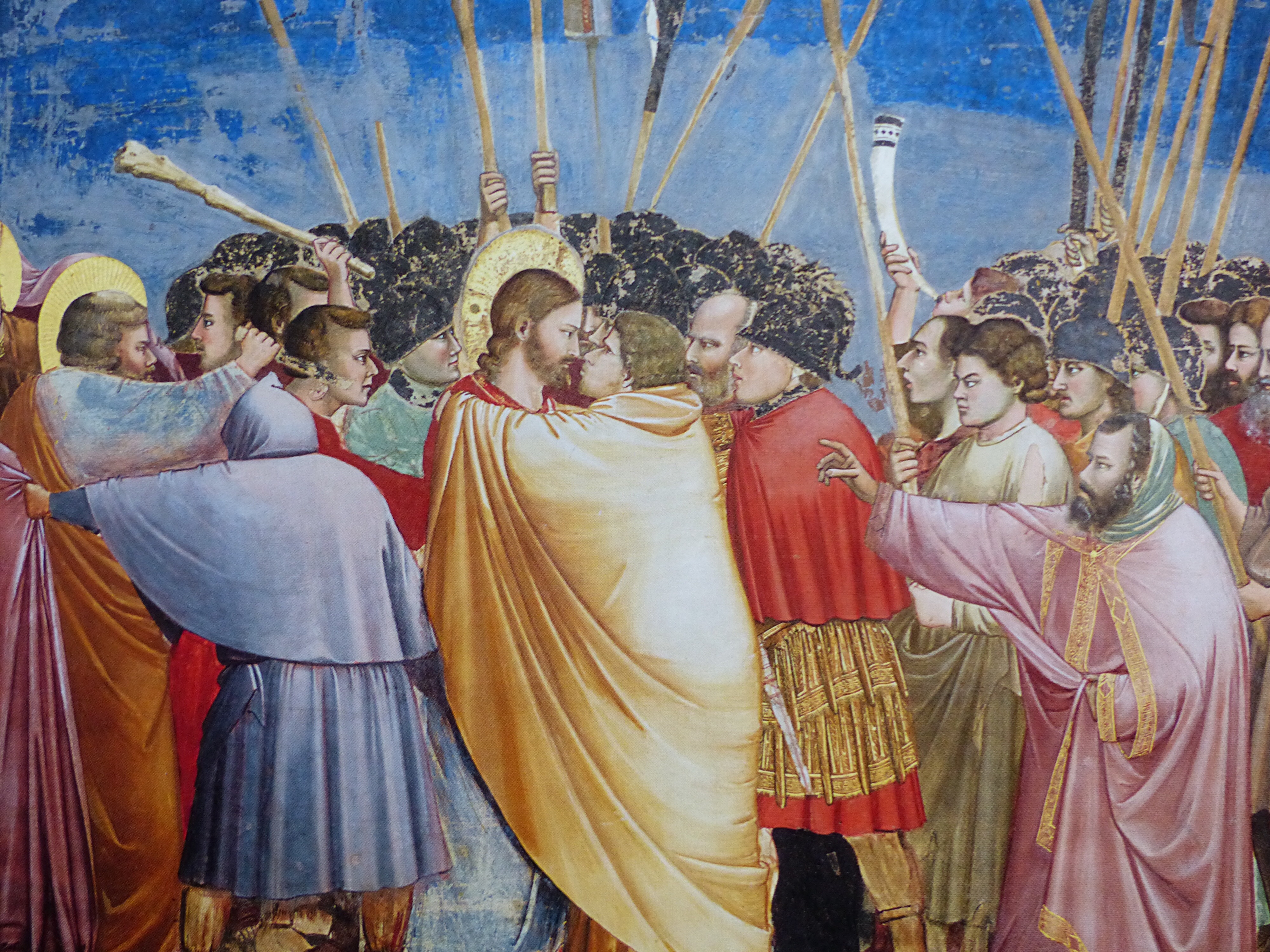
 Giotto, Kiss of Judas


Wonderful Bharatiya woman Hair style on a statue at Sri Bhuvaraha Swamy Temple in Srimushnam, Cuddalore district of Tami Nadu.

 
Chess: "Giotto" "Giotto's "O" "Magister" "Magisterial" "Maestro" "Magistral" "Master" "Travel" "Chase Manhattan" "Florence" "Robert Burns"
 
 
 Robert Burns Cottage.
This is the house in Alloway Ayrshire where Robert Burns was born on the 25th of January 1759, he grew up to be one of Scotland’s most beloved and celebrated poets, his works included Auld Lang Syne, Scots Wha Hae, Tam o’ Shanter and To a Mouse.
Poem.
To a Mouse, on Turning Her Up in Her Nest With the Plough,
Wee, sleekit, cowrin, tim'rous beastie,
O, what a pannic's in thy breastie!
Thou need na start awa sae hasty,
Wi' bickering brattle!
I wad be laith to rin an' chase thee,
Wi' murd'ring pattle!
I'm truly sorry man's dominion,
Has broken nature's social union,
An' justifies that ill opinion,
Which makes thee startle
At me, thy poor, earth-born companion,
An' fellow-mortal!.

Thursday, November 5, 2015

O

O
Giotto
Momotombo
Guayabo
Florida
Sunshine
"LL" 
Cambute

Psalm 50:12


"If I were hungry, I would not tell thee: for the world is mine, and the fulness thereof."


Giotto
6. Meeting at the Golden Gate: San Joaquín y Santa Ana
1304-06
Fresco, 200 x 185 cm
Cappella Scrovegni (Arena Chapel), Padua


The hug and kiss in The Meeting at the Golden Gate are between by St Joachim and St Anne, the parents of Mary, the mother of Jesus. It is an extremely significant kiss: if it hadn't been, Giotto would not have painted it. According to Christian doctrine, Mary was born "immaculate", without the inherited taint of human sin. And according to Christian legend, her parents conceived her without having sex. An angel directed the childless couple to go separately to the Golden Gate in Jerusalem. When they meet, they kiss - and out of this kiss Mary is engendered.
The picture has striking details: the gateway's golden arch, the use of black in the cloak of one woman, and the herdsman (he's a figure in the story, too) who enters half cut-off by the picture's edge. But the foreground embrace is the main event. As these two massive bodies gently lay hands on each other, Giotto unites their forms into a single pointed arch.
The fusion of faces is even more forceful (look as close as you can). Their haloes intersect. Their hairlines join up. Their eyes meet to make a single pair of eyes. And there's a crucial volumetric impossibility, in the way that face touches face. For it seems that Anne's head passes behind Joachim's, as if she's just giving him a kiss on the cheek. Yet, at the mouth, her lips have come forward, and are directly pressed against his lips.
The faces squash. The volumes of brow and cheek and nose that would get in the way of this contact are somehow elided, compacted. With a flat icon, it wouldn't be felt, but with these so solid Giotto heads, you're made to experience a great passionate pressing and locking together of two separate beings.


Giotto di Bondone, Legend of St Joachim, Meeting at the Golden Gate, 1305 is an early depiction of the scene.
In the last fresco of the upper register the composition is concentrated on the encounter between Joachim and Anne: Joachim is accompanied by a shepherd, who is partly cut off in the fresco. On the one hand, Giotto uses this completely new device in painting to create the impression that the succession of pictures, intersected by the framework, would unfold before our eyes in one continuous procession. On the other hand, a figure cut short in such a manner increases the dynamics within the picture field and makes us focus on the action at its centre.
Even the verticals of the architecture and the golden arch of the city gate respectively illustrate and mirror the way the couple lean towards one another. The two meet on a bridge, on the border between the outside world and the security of the city. They embrace with great tenderness and kiss one another. The way in which the volumes of the figures fuse underlines the tenderness of the moment, in which the faces also melt, as it were, into one another.
The story of Mary's parents begins with a painful rejection and concludes with this intense encounter. The sensitive portrayal of their meeting already contains the germ for the start of the next narrative, which commences with the Birth of the Virgin Mary and which leads to the youth of Christ by way of the Bridal Procession of the Virgin.


Momotombo Volcano, Nicaragua


Momotombo Volcano, Leon, Nicaragua. Momotombo is a stratovolcano not far from the city of León. It stands on the shores of Lago de Managua. An eruption of the volcano in 1610 forced inhabitants of the Spanish city of León to relocate about 30 miles west


Monumento Nacional Guayabo  - Costa RicaEl Monumento Nacional Guayabo (izquierda), en Turrialba, es el principal sitio arqueológico del país


Holguin, Cuba El Salto Guayabo . photo by Raul Pulpo 


 Florida
Caladesi Island State Park, near Tampa - only accessible by ferry or private boat. Once there you can kayak through the mangroves, hike or picnic on the beach  


Florida's State Shell the Horse Conch... state bird is the Mockingbird, state flower is the Orange Blossom, tree is the Cabbage (Sabal) Palm, and of course, it's nickname is the Sunshine State.


Chess: "O" "Momotombo" "Guayabo" "Florida" "Sunshine" "Giotto" "LL" "Cambute"


Bondone, di Giotto: The Meeting at the Golden Gate (1305)

The Independent's Great Art series


The Meeting at the Golden Gate is one of the hardest to see of the frescos in the Scrovegni Chapel in Padua. It's in the topmost of the three bands of pictures, and at the end of a row, and your natural viewing position is by the entrance of the chapel, where there isn't room to stand back enough. Only the elevated, four-square eye of the camera can reveal what Giotto and his assistants saw when they painted it 700 years ago. As with many of Giotto's effects, the power of this kiss derives from how he does bodies.
The enormous solidity of Giotto's figures has always been appreciated. An early commentator, Cennino Cennini, said that Giotto had "translated the art of painting from Greek into Latin", meaning that he'd changed it from the flatness of a Greek-Byzantine icon to the solidity of a Roman statue. But the solidity wasn't consistently admired. To later, anatomically sophisticated eyes, the stout Giotto body could look like inarticulate bulk. The Irish neoclassical painter James Barry observed that, in Giotto, "all the parts of the body are much confounded together... they are (particularly in their flexures) as inartificially drawn as if copied from the bendings of a sandbag". What a brilliant description of Giotto's elbows: the bendings of a sandbag.
But for some 20th-century artists, this stout sandbag quality was exactly what they liked, and tried to imitate. It looked honest, primitive, childlike. It's Giotto who inspires Stanley Spencer's tubby, cuddly characters. "What ho! Giotto!" was his cry, when he got the commission to paint the Sandham Memorial Chapel. It was a dream come true, a chance to do a modern version of the Padua frescos.
The actual figures in Padua are too solemn to be cuddly. But their inflexible massiveness gives them a slowness of manoeuvre, a steadiness and a carefulness in the way they make contact with the world and each other. They seem incapable of committing or suffering violence (and it always feels wrong when the story compels them to be violent). Their characteristic gesture is the laying on of hands. They are great huggers.
The hug and kiss in The Meeting at the Golden Gate are between by St Joachim and St Anne, the parents of Mary, the mother of Jesus. It is an extremely significant kiss: if it hadn't been, Giotto would not have painted it. According to Christian doctrine, Mary was born "immaculate", without the inherited taint of human sin. And according to Christian legend, her parents conceived her without having sex. An angel directed the childless couple to go separately to the Golden Gate in Jerusalem. When they meet, they kiss - and out of this kiss Mary is engendered.
The picture has striking details: the gateway's golden arch, the use of black in the cloak of one woman, and the herdsman (he's a figure in the story, too) who enters half cut-off by the picture's edge. But the foreground embrace is the main event. As these two massive bodies gently lay hands on each other, Giotto unites their forms into a single pointed arch.
The fusion of faces is even more forceful (look as close as you can). Their haloes intersect. Their hairlines join up. Their eyes meet to make a single pair of eyes. And there's a crucial volumetric impossibility, in the way that face touches face. For it seems that Anne's head passes behind Joachim's, as if she's just giving him a kiss on the cheek. Yet, at the mouth, her lips have come forward, and are directly pressed against his lips.
The faces squash. The volumes of brow and cheek and nose that would get in the way of this contact are somehow elided, compacted. With a flat icon, it wouldn't be felt, but with these so solid Giotto heads, you're made to experience a great passionate pressing and locking together of two separate beings.
About the artist
Giotto di Bondone (c1267-1337) is a founding presence in Western painting. The Florentine master introduced 3D, in the solid volumes of his bodies and receding depths of his spaces. Legend cast him as a simple shepherd boy, discovered in the hills by the artist Cimabue doing pictures of sheep. His most famous work, the Navicella in St Peter's, Rome, decayed and has been repainted beyond recognition. But the great fresco cycles in Padua, Florence, and Assisi still survive.