Wednesday, April 27, 2016

Cáceres

Cáceres
Abel Pacheco
Golfo de Fonseca
Golden Gate Bridge
Gulf of Mexico
Pont Du Gard

Prov.16:3
"Commit thy works unto the LORD, and thy thoughts shall be established."

 Gen.1:26
"And God said, Let us make man in our image, after our likeness: and let them have dominion over the fish of the sea, and over the fowl of the air, and over the cattle, and over all the earth, and over every creeping thing that creepeth upon the earth."


"If rye or wheat be lodged, cut it though it be not ripe."~~~Robert Browning


"his devotion to poetry was his one constant lodestar"~~~Philip Horton


Pont du Gard Roman aqueduct, South of France.


Abel Pacheco de la Espriella
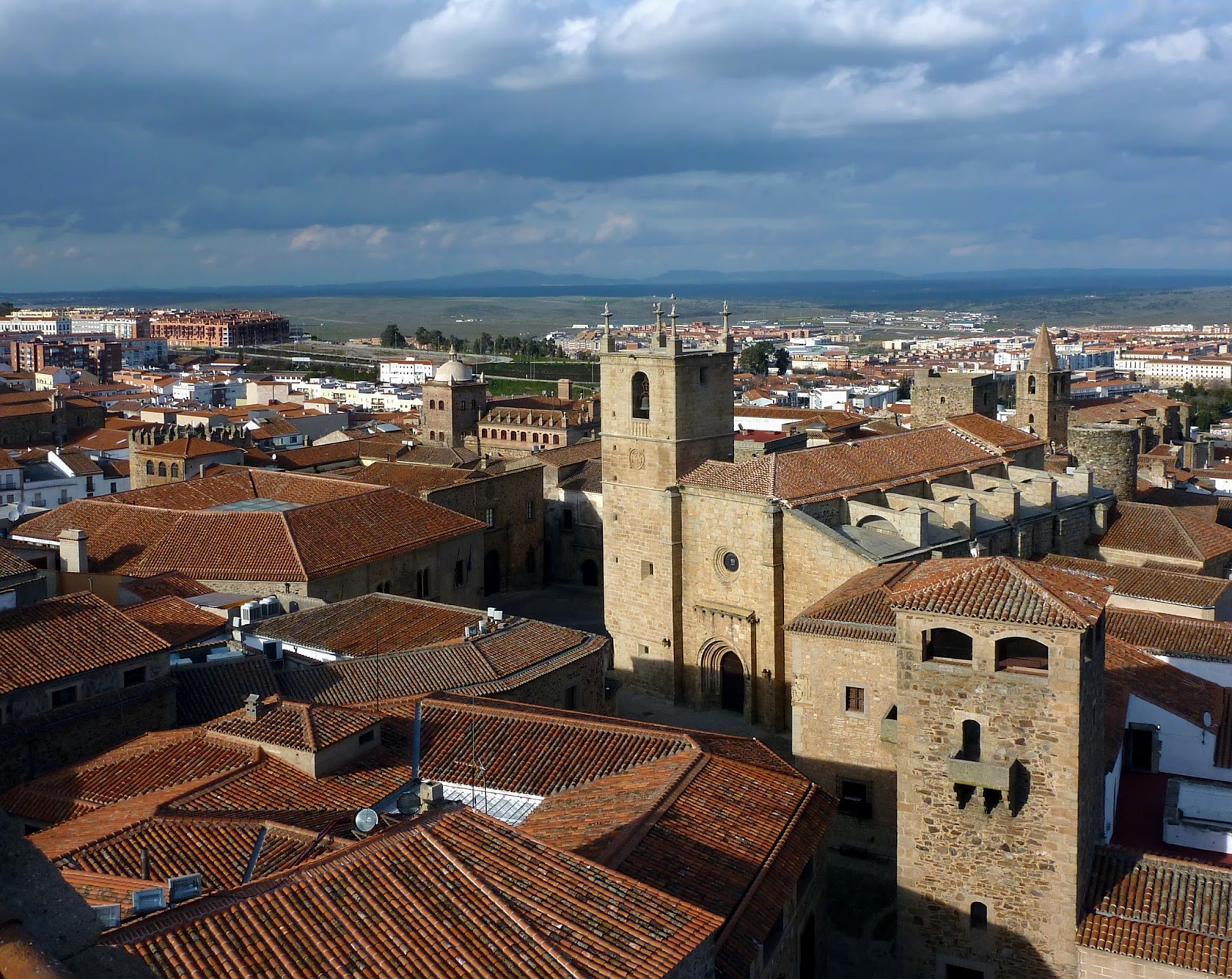


 Cáceres
View of the old town and its surroundings.


 Gulf of Mexico


Golden Gate Bridge, San Francisco Bay


Chess: "Cáceres" "Abel Pacheco" "Golfo de Fonseca" "Golden Gate Bridge" "Gulf of Mexico"


Cáceres, Spain

History

There have been settlements near Cáceres since prehistoric times. Evidence of this can be found in the caves of Maltravieso and El Conejar.[1] The city was founded by the Romans in 25 BC.
The Old Town (Parte Antigua) still has its ancient walls; this part of town is also well known for its multitude of storks' nests. The walls contain a medieval town setting with no outward signs of modernity, which is why many films have been shot there . TheUniversidad de Extremadura, and two astronomical observatories are situated in Cáceres. The city is also a seat of the Roman Catholic Diocese of Coria-Cáceres.
Cáceres was declared a World Heritage City by UNESCO in 1986 [2]because of the city's blend of Roman, Moorish, Northern Gothic and Italian Renaissance architecture. Thirty towers from the Islamic periodstill stand in Cáceres, of which the Torre del Bujaco is the most famous.

Wednesday, April 6, 2016

Caput

Caput
Head
Ahead
Intelligence
Logos

Gen.1:26
"And God said, Let us make man in our image, after our likeness: and let them have dominion over the fish of the sea, and over the fowl of the air, and over the cattle, and over all the earth, and over every creeping thing that creepeth upon the earth."


"If rye or wheat be lodged, cut it though it be not ripe."~~~Robert Browning


"his devotion to poetry was his one constant lodestar"~~~Philip Horton


The Old Sea-dog at the "Admiral Benbow"

SQUIRE TRELAWNEY, Dr. Livesey, and the rest of these gentlemen having asked me to write down the whole particulars about Treasure Island, from the beginning to the end, keeping nothing back but the bearings of the island, and that only because there is still treasure not yet lifted, I take up my pen in the year of grace 17__ and go back to the time when my father kept the Admiral Benbow inn and the brown old seaman with the sabre cut first took up his lodging under our roof. 

"Well, then," said he, "this is the berth for me. Here you, matey," he cried to the man who trundled the barrow; "bring up alongside and help up my chest. I'll stay here a bit," he continued. "I'm a plain man; rum and bacon and eggs is what I want, and that head up there for to watch ships off. What you mought call me? You mought call me captain. Oh, I see what you're at—there"; and he threw down three or four gold pieces on the threshold. "You can tell me when I've worked through that," says he, looking as fierce as a commander.~~~Robert Louis Stevenson


The Olmec culture was the first great Mesoamerican civilization, developing along Mexico's gulf coast from about 1200-400 B.C. before going into a mysterious decline. The Olmec were very talented artists & sculptors who are today best remembered for their monumental stonework and cave paintings.


Chess: "Caput" "Head" "Ahead" "Intelligence" "Logos"


Friday, March 18, 2016

Ole

Olé
Allah (Oh, Dios)
Grand OLE Opry
Grand OLE Party
Wella

Gen.2:7
 "And the LORD God formed man of the dust of the ground, and breathed into his nostrils the breath of life; and man became a living soul."

Mose2:7


"Und Gott der HERR machte den Menschen aus einem Erdenkloß, uns blies ihm ein den lebendigen Odem in seine Nase. Und also ward der Mensch eine lebendige Seele."

 Genesis 2:7

"formavit igitur Dominus Deus hominem de limo terrae et inspiravit in faciem eius spiraculum vitae et factus est homo in animam viventem"


Mosaics,ISLAMIC ART AND ARCHITECTURE


Extraordinary Mosque Ceilings That Shows The Brilliance Of Islamic Architectures


Zayed Grand Mosque, Abu Dhabi


Carrie Underwood performs at The Grand Ole Opry on June 3, 2014 in Nashville, Tennessee.


Carrie Underwood's Intense 'Heartbeat' Performance on the Opry | Rolling Stone


Brooke Shields: La última Foto del Shampoo Wella.


Chess: "Olé" "Allah (Oh, Dios)" "Grand OLE Opry" "Grand OLE Party" "Wella"

¿De dónde viene la palabra “olé”?

ole
¡Olé, olé y olé! Con acento en la “o” o con acento en la “e” y alargando las vocales tanto como nos lo pida el alma. Es una palabra clave del español y tal vez la más característica –preguntádselo si no a los guiris-.
Todos, quien más quien menos, lo decimos cuando estamos contentos –y en especial los aficionados al mundo taurino y al flamenco-; y todos nos hemos preguntado alguna vez cuál es el origen de esta singular interjección intraducible a otros idiomas.
alhambra
Existen muchas hipótesis sobre el origen de la palabra “¡olé!”: hay quienes afirman que vienedel griego, del verbo “ololizin” (ὀλολύζειν), que es una palabra onomatopéyica y designa el grito ritual de júbilo de duelo.
Hay quienes también dicen que “¡Olé!” viene del episodio de la Biblia en el que Jacob es engañado el día de su boda con Raquel, al quitar el velo a la novia, descubre que en realidad se trata de Lea, no de Raquel. El público durante la ceremonia, intenta avisarle “¡Oh, Lea!”. Y de ahí derivó a olé.
Pero la hipótesis más extendida y la que más cuerpo tiene es aquella que dice que “¡olé!” viene del árabe, de la expresión “allah” (Oh, Dios), concretamente.
Todos sabemos la enorme influencia que ha tenido el árabe en el español, y es que siete siglos de invasión árabe dieron para mucho, sobre todo para dejar un buen legado cultural, artístico y lingüístico. Se dice que más de 4.000 palabras del español provienen del árabe. Y “olé” es una de ellas.
arabes
Según la escritora estadounidense Elizabeth Gilbert, “¡olé!” viene de la exclamación de “¡Alá!” (Allah). Los moros solían hacer grandes celebraciones que incluían espectáculos de baile. Cuando un bailarín lograba maravillar al público con sus movimientos llenos de gracia y su arte de gran nivel, se creía que ese momento permitía a los testigos entrever el poder de Alá a través del bailarín. Por eso, cuando los bailarines embrujaban al público, este exclamaba “¡Alá!”.
La RAE, por otra parte, recoge que “¡olé!” proviene de la exclamación árabe Wa-(a)llah (¡Por Dios!), una exclamación de entusiasmo ante una belleza o alegría sorprendente o excesiva. En el idioma árabe, no existe la vocal “e” y, en ocasiones, la vocal “a” suena parecido a la “e”.
Sea como sea, poco a poco, la palabra fue perdiendo conexión con el Dios de los musulmanes; pero sigue manteniendo ese concepto de sorpresa y maravilla ante algo bello y asombroso, que nos deja boquiabiertos y nos incita a aplaudir. Bien sea una fabulosa actuación musical, un gol de nuestro equipo de fútbol, o, simplemente, expresar alegría ente una buena noticia. Aunque principalmente se emplee en el mundo del flamenco y el toreo.

Wednesday, March 16, 2016

Ecuador

Ecuador
Eden
Holstein
Design
Blueprint
David

Prov.29:27
"An unjust man is an abomination to the just: and he that is upright in the way is abomination to the wicked."

Gen.2:8
"And the LORD God planted a garden eastward in Eden; and there he put the man whom he had formed."


"The West Indian climate is...the most equable in the world"~~~Alec Waugh


"Elizabeth found herself quite equal to  the scene"~~~Jane Austen


 Ecuador


Ecuador


Holstein


Dynamic waves design


Blueprint Project


Red Wine


Chess: "Ecuador" "Eden" "Holstein" "Design" "Blueprint" "David"

Monday, March 14, 2016

Integral

Integral
Curve
Range
Quality
Rank

Prov.29:26
Many seek the ruler's favour; but every man's judgment cometh from the LORD. 

Lev.23:22 
"And when ye reap the harvest of your land, thou shalt not make clean riddance of the corners of thy field when thou reapest, neither shalt thou gather any gleaning of thy harvest: thou shalt leave them unto the poor, and to the stranger: I am the LORD your God."


The Sower, June 1888, Kröller-Müller Museum, Otterlo. Inspired byJean-François Millet Van Gogh made several paintings after The Sower by Millet


"Sheaves of Wheat" by Vincent Van Gogh


Definite integral example

Chess: "Integral" "Curve" "Range" "Quality" "Rank"

Wheat Fields (Van Gogh series)

 The Wheat Fields is a series of dozens of paintings by Vincent van Gogh, borne out of his religious studies and sermons, connection to nature, appreciation of manual laborers and desire to provide a means of offering comfort to others. The wheat field works demonstrate his progression as an artist from the drab Wheat Sheaves made in 1885 in the Netherlands to the colorful, dramatic paintings from Arles, Saint-Rémy and Auvers-sur-Oise of ruralFrance.


Spiritual significance

As a young man Van Gogh pursued what he saw as a religious calling, wanting to minister to working people. In 1876 he was assigned a post in Isleworth, England to teach Bible classes and occasionally preach in the Methodistchurch.
When he returned to the Netherlands he studied for the ministry and also for lay ministry or missionary work without finishing either field of study. With support from his father, Van Gogh went to Borinage in southern Belgium where he nursed and ministered to coal miners. There he obtained a six-month trial position for a small salary where he preached in an old dance hall and established and taught Bible school. His self-imposed zeal and asceticism cost him the position.[5]
After a nine-month period of withdrawal from society and family; he rejected the church establishment, yet found his personal vision of spirituality, "The best way to know God is to love many things. Love a friend, a wife, something - whatever you like - (and) you will be on the way to knowing more about Him; this is what I say to myself. But one must love with a lofty and serious intimate sympathy, with strength, with intelligence."[5] By 1879, he made a shift in the direction of his life and found he could express his "love of God and man" through painting.
Drawn to Biblical parables, Van Gogh found wheat fields metaphors for humanity's cycles of life, as both celebration of growth and realization of the susceptibility of nature's powerful forces.
  • Of the Biblical symbolism of sowing and reaping Van Gogh taught in his Bible lessons: "One does not expect to get from life what one has already learned it cannot give; rather, one begins to see more clearly that life is a kind of sowing time, and the harvest is not here."
  • The image of the sower came to Van Gogh in Biblical teachings from his childhood, such as:
"A sower went out to sow. As he sowed, some seed fell along the path, and the birds came and devoured it. Other seed fell on rocky ground, where it had not much soil, and immediately it sprang up, since it had no depth of soil; and when the sun rose it was scorched, and since it had no root it withered away. Other seed fell among thorns and the thorns grew up and choked it, and it yielded no grain. And other seeds fell into good soil and brought forth grain, growing up and increasing and yielding thirty fold, and sixty fold and a hundredfold.(Mark 4:3-8)[7]
  • Van Gogh used the digger and ploughman as symbols of struggle to reach the kingdom of God.
  • He was particularly enamored with "the good God sun" and called anyone who didn't believe in the sun infidels. The painting of the haloed sun was a characteristic style seen in many of his paintings,[9] representing the divine, in reference to the nimbus in Delacroix's Christ Asleep During the Tempest.[10]
  • Van Gogh found storms important for their restorative nature, symbolizing "the better times of pure air and the rejuvenation of all society." Van Gogh also found storms to reveal the divine.